Before children are ready to read words or write letters, they need time to listen, notice, move, speak, remember, and make meaningful marks. Ready for Reading and Writing was created to help young children in Burundi build those foundations in a way that fits their age, culture, and classrooms.
A Preschool Literacy Curriculum for Burundi
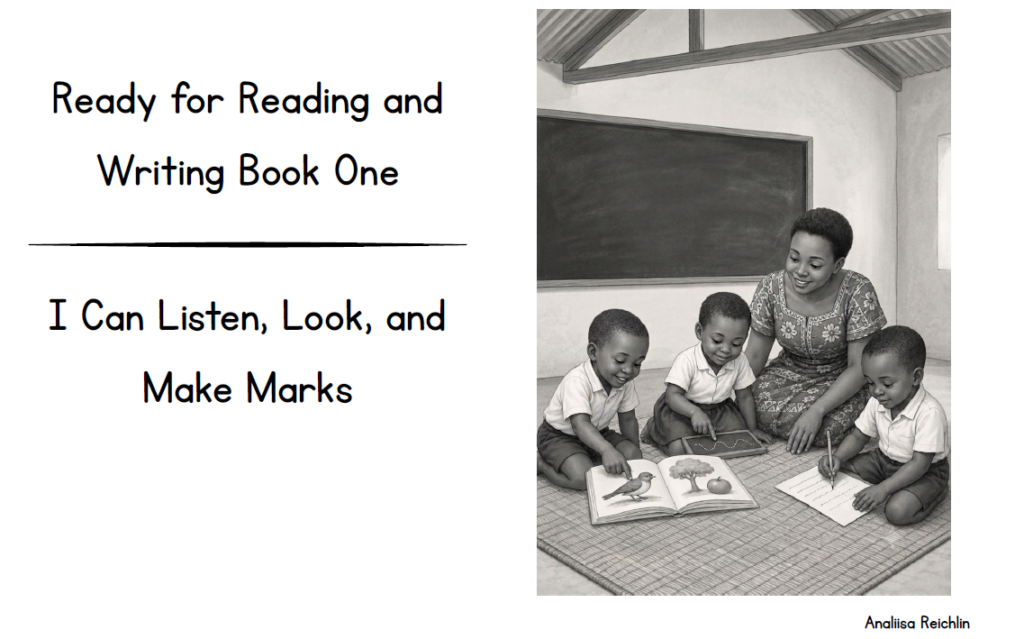
Over the past year, we have been creating something I am very excited to share: Ready for Reading and Writing, Book One: I Can Listen, Look, and Make Marks.
This is the first in a planned series of three books for Nursery 1, Nursery 2, and Nursery 3. Together, the series is designed to help young children in Burundi build the skills they need before they begin formal reading and writing.
Book One was created for children around age three.
At first glance, some of the activities may look simple. A child might point to a picture, listen for a sound, draw a line, complete a pattern, or notice what is missing.
But those simple activities are building important foundations.
Before children are ready to read words and write letters, they need to learn how to listen carefully, follow directions, notice differences, remember what they hear, control the movement of their hands, and recognize patterns in sounds and pictures.
Those skills grow through conversation, movement, repetition, play, and warm interaction with an attentive adult.
That is what this book is designed to support.
Why We Are Not Starting With Letters
It can be tempting to think preschool children are learning more when they are tracing letters or copying numbers.
But a child can copy the shape of a letter without understanding what it represents or how it connects to spoken language.
Before a child can hear that two words begin with the same sound, she must first learn to listen closely. Before she can tell letters apart, she must notice small visual differences. Before she can write letters, she needs practice making lines, curves, circles, and controlled marks.
So Book One does not rush children into formal reading or handwriting.
Instead, children listen, talk, point, move, compare, remember, draw, and play. The workbook gives them a place to practice, but the page itself is never the whole lesson.
More Than a Workbook
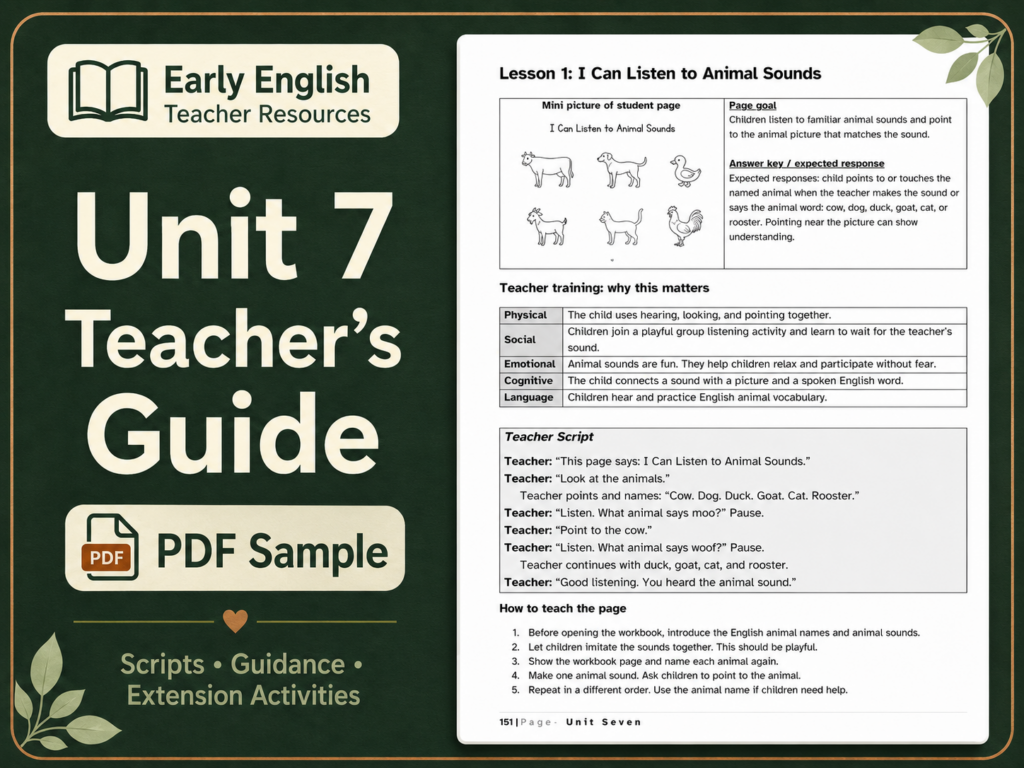
One of the most important parts of this project is the accompanying Teacher’s Guide.
Each lesson explains what the child is learning, what the teacher can say, how to introduce the activity, and how to help a child who is not ready to complete it independently.
The guide also includes ideas for movement, conversation, games, and hands-on practice.
For example, a lesson about lines may begin with children moving their arms, walking along a line, finding straight lines in the classroom, or drawing large lines in the air before making smaller lines on paper.
A lesson about sounds may begin with the teacher saying familiar words aloud while the children clap, point, repeat, or listen for words that sound alike.
The workbook is not meant simply to keep children quietly occupied. It is a tool that supports interaction between the teacher and the child.
Filling a Gap in Burundi
In many rural communities in Burundi, there is a need for practical preschool materials and teacher support designed specifically for very young children.
The gap is not simply a lack of worksheets.
It is a lack of developmentally appropriate materials that show teachers both what to do and why it matters.
Many school materials move quickly toward memorization, copying, reciting, and correct answers. Those skills may have a place later, but they do not fully reflect how young children learn.
Young children learn through relationships, movement, conversation, repetition, real objects, and discovery.
Ready for Reading and Writing is our attempt to bring those principles into a form that is practical for Burundian preschool classrooms.
Made for the Children Who Will Use It
We have worked hard to make the books familiar and culturally appropriate.
The pictures include animals, homes, classrooms, clothing, household objects, transportation, and scenes from everyday life in Burundi.
The activities are also designed for the realities of rural classrooms. They do not depend on expensive toys, technology, or large amounts of craft material.
Most use things already available: voices, hands, movement, crayons, pencils, stones, sticks, bottle caps, classroom objects, and materials from the surrounding environment.
Our goal is not to import an American preschool classroom into Burundi.
Our goal is to apply what we know about child development while listening carefully to Burundian teachers and adapting the materials to their children, classrooms, culture, languages, and resources.
Helping Teachers Understand Development
The Teacher’s Guide also helps teachers observe children without labeling them too quickly.
A three-year-old who cannot yet draw a controlled circle is not failing. A child who needs a direction repeated may not be disobedient. A child who struggles to find a matching picture may simply need more experience looking carefully.
The guide encourages teachers to ask, “What skill is still developing?” rather than, “Why can’t this child do the page?”
That shift matters.
Children do not all develop at the same pace. The goal is not to pressure them into performing before they are ready. It is to notice what they can do, offer the next appropriate experience, and give them time to grow.
The Beginning of a Three-Book Series
Book One is only the beginning.
The full Ready for Reading and Writing series will include:
- Book One: Nursery 1
- Book Two: Nursery 2
- Book Three: Nursery 3
Each book will build on the skills developed in the previous level, gradually moving children from early listening, language, observation, and mark-making toward formal reading and writing.
We are not trying to make three-year-olds look more academically advanced.
We are helping them build the foundation they will need when it truly is time to read and write.
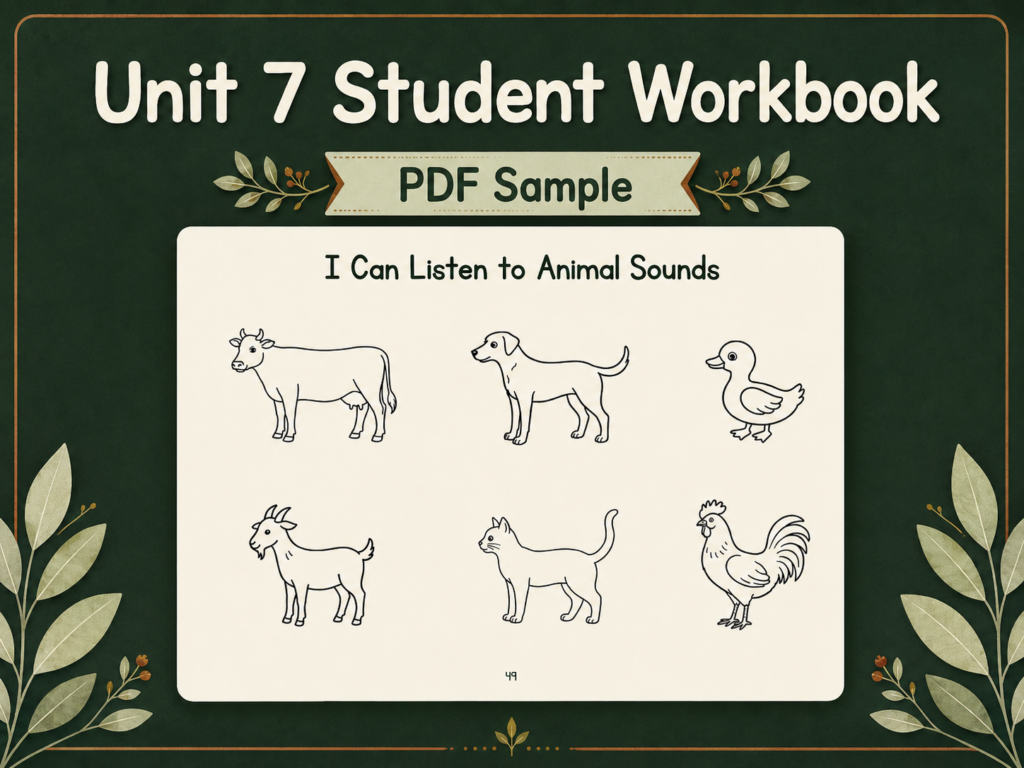
In this post, I shared one sample unit from the student workbook and the matching section of the Teacher’s Guide. The student pages show what the children see. The Teacher’s Guide shows the much larger lesson happening around them. Click the images above to view the Unit 7 student workbook and the matching Teacher’s Guide.
Help Us Continue the Work
Ready for Reading and Writing, Book One is the first in a three-book series for Nursery 1, Nursery 2, and Nursery 3. Your support helps us continue developing, printing, and placing these resources in the hands of Burundian teachers.